Friday, November 28, 2014

The GOMOS QWG

Hello,

during this week I participated for the first time the GOMOS quality working group (QWG) meeting held at European space research institute (ESRIN) that is dedicated to European Space Agency's Earth-observing activities, in Frascati, Italy.

We had some nice discussion about GOMOS quality and I personally presented one task related to the ALGOM project. My task is related to possible improvements of GOMOS ozone at UTLS altitudes using the so-called OneStep approach. OneStep is of course related to my PhD thesis and in particular this paper. The results so far show that, in fact, we can drastically improve the quality of GOMOS UTLS ozone using OneStep algorithm and 1/λ aerosol model.

After the QWG meeting myself, Erkki and Viktoria had some time to visit the eternal city of Rome:
The white thing that you seen on the background is the national monument to Vittorio Emmanuel II.

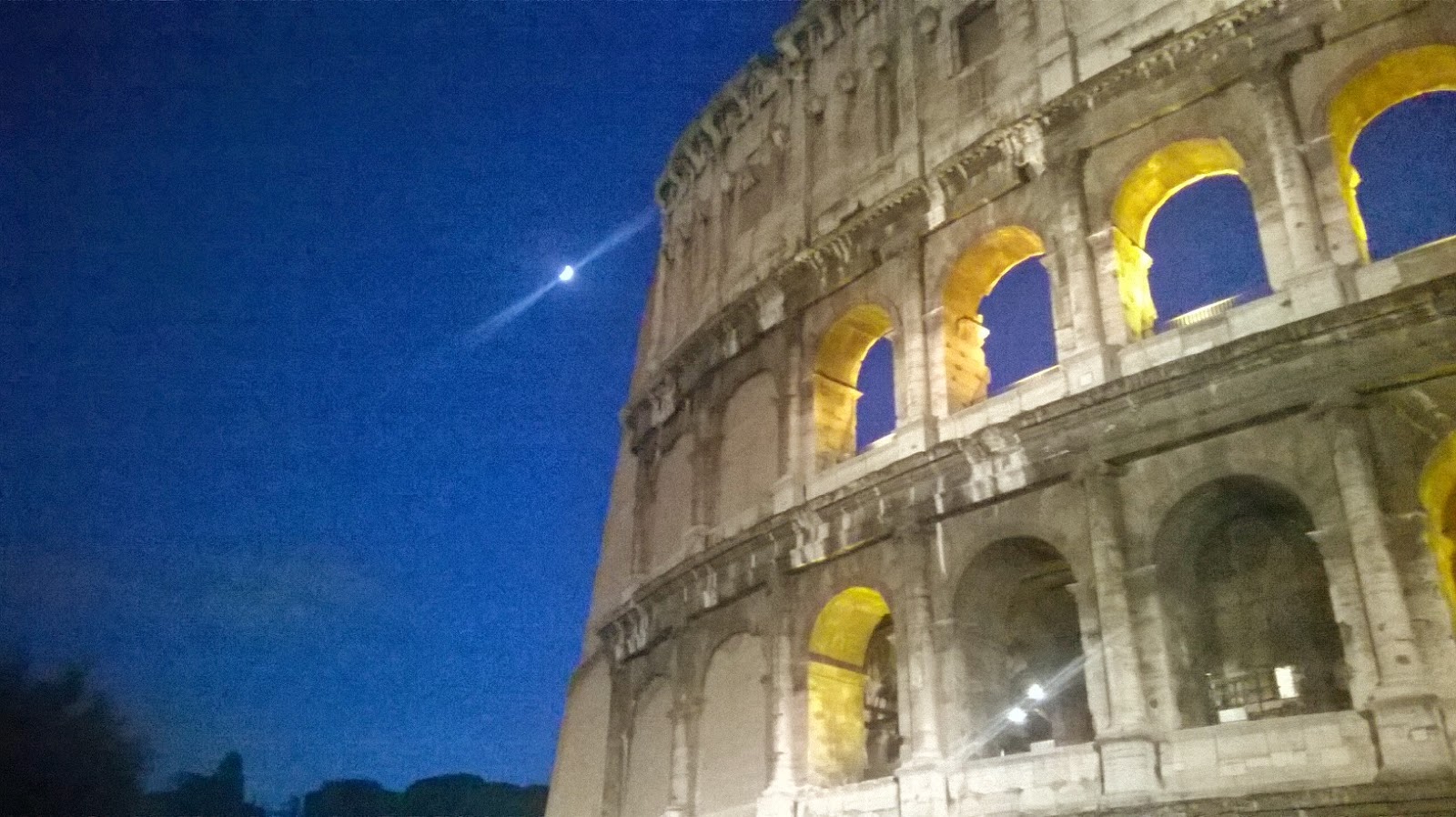
This of course is the Colosseum with the Moon.

This is my old home in San Lorenzo. I spent the academic year of 2006/2007 studying at Università degli studi Roma Tre.
Saluti da Roma,

Janne

Friday, October 3, 2014

Inverse problems

Hello,

yesterday I got an invitation to the 20th Inverse Days organized by The Finnish Inverse Problems Society (Suomen inversioseura ry). They have also put together a Youtube teaser and in that way I found myself watching various Youtube videos about ”inverse problems”.

Here are two of them. First one is Nutti Hyvönen’s installation lecture at Aalto University 


and the second one is an interview of my PhD supervisor Heikki Haario.


They are quite interesting. So check them out!

Loosely speaking, all the research that I do is somehow how related to these inverse problems. So now you now what I do :-)

Ciao,

Janne

Thursday, October 2, 2014

Estimating model error covariance matrix parameters in extended Kalman filtering

Hello,

about a month ago, Antti's paper "Estimating model error covariance matrix parameters in extended Kalman filtering" got published in Nonlinear Processes in Geophysics. It is a continuation of long series of papers, e.g., p1, p2, p3, p4, and also related to the main topic of my doctoral dissertation.

The paper discusses how Filter Likelihood -technique can be used for estimating the parameters of the model error covariance matrix in extended Kalman filtering. The paper shows that (a) the importance of the model error covariance matrix calibration depends on the quality of the observations, and that (b) the estimation approach yields a well-tuned EKF in terms of the accuracy of the state estimates and model predictions.

Today FMI published a tiedeuutinen about it. This is what came out:

Uusi menetelmä data-assimilaatiosysteemin säätämiseen

Vastajulkaistussa tutkimuksessa esitetään objektiivinen numeerinen menetelmä, jonka avulla data-assimilaation parametrit voidaan säätää kohdilleen, jotta säämalli ja havaintodata sulautuvat hyvin toisiinsa.

Data-assimilaatio on tekniikka, jonka avulla säämalli ja havaintodata voidaan sulauttaa yhteen. Se onkin keskeinen työkalu esimerkiksi numeerisessa säänennustamisessa. Useisiin data-assimilaatiotekniikoihin sisältyy termi, jonka tarkoituksena on kuvata sitä virhettä, jonka malli tekee liikuttaessa aikapisteestä toiseen. Toisaalta sen tarkoituksena on myös kompensoida niitä virheitä, joita itse data-assimilaatiosysteemiin liittyy. Perinteisesti on ajateltu, että tämä termi on mallintajan säätöparametri, jonka mallintaja asettaa käsin.

Uudessa tutkimuksessa voitiin osoittaa, että säädön tarpeellisuus riippuu olennaisesti käytettävien havaintojen tarkkuudesta ja määrästä.  Tutkimuksessa esitelty numeerinen algoritmi antaa hyvin säädetyn ennustesysteemin, jossa koko ennustesysteemin ennustevirhe on samassa suhteessa simuloidun oikean ennustevirheen kanssa.

Tutkimus on julkaistu kansainvälisessä Nonlinear Processes in Geophysics -tiedelehdessä ja siihen on osallistunut tutkijoita Ilmatieteen laitokselta, Lappeenrannan teknilliseltä yliopistolta ja  Aalto-yliopistolta. Tutkimus on tehty osana Suomen akatemian laskennallisten tieteiden tutkimusohjelmaan kuuluvaa NOVAC-projektia.

Lisätiedot:
Tutkija Antti Solonen, antti.solonen@gmail.com
Tutkija Janne Hakkarainen, janne.hakkarainen@fmi.fi

Linkki tutkimukseen: http://www.nonlin-processes-geophys.net/21/919/2014/

Check it out!

Citation: Solonen, A., Hakkarainen, J., Ilin, A., Abbas, M., and Bibov, A.: Estimating model error covariance matrix parameters in extended Kalman filtering, Nonlin. Processes Geophys., 21, 919-927, doi:10.5194/npg-21-919-2014, 2014.

Cheers,

Janne

Monday, September 29, 2014

Satellite Observations of Ash and SO2 from recent Volcanic Eruptions in Iceland

Hey guys,

this morning I submitted the following to the Finnish Remote Sensing Days 2014.

See you there!

Janne
Satellite Observations of Ash and SO2 from recent Volcanic Eruptions in Iceland
Janne Hakkarainen, Iolanda Ialongo, Simo Tukiainen, Rigel Kivi, Timo Ryyppö, Seppo Hassinen, and Johanna Tamminen

Finnish Meteorological Institute
P.O. BOX 505, FI-00101 Helsinki, Finland

Sulphur dioxide (SO2) has been measured from space since the 1982 eruption of El Chichòn [1]. Those measurements were carried out by Total Ozone Mapping Spectrometer (TOMS), which had a limited SO2 detection sensitivity, since the discrete measurement wavelengths were designed for total ozone measurements. Since those days, next-generation space-borne spectrometers like GOME, SCIAMACHY and OMI (Ozone Monitoring Instrument) have shown greatly improved SO2 detection sensitivity. These days, SO2 from volcanic eruptions and degassing are routinely monitored.

Satellite measurements of volcanic SO2 emissions can provide critical information for aviation hazard mitigation, particularly when ash detection techniques fail [2]. SO2 has low background making the volcanic SO2 plumes clearly distinguishable even long distance from source. For example systems like SACS (Support to Aviation Control Service, http://sacs.aeronomie.be) use SO2 as an indicator for volcanic activity and send email notifications when instrument specific thresholds are exceeded.

The fastest way to produce satellite data is to use the so-called direct-broadcast technique where the instruments measure the atmosphere and simultaneously send the data down to Earth for processing. These direct-readout data are provided about 15 min after the satellite overpasses the ground station. One of such systems was the Finnish OMI very fast delivery (VFD) service put together in 2004 for ozone and UV products. OMI VFD was updated in 2010—after the ill- famous Eyjafjallajökull eruption—for SO2 and aerosol products in order to monitor volcanic clouds. In 2011, OMI VFD system successfully monitored Grimsvötn eruption and both SO2 and aerosols were observed [3]. In 2014, new satellite observations from OMPS (Ozone Mapping and Profiler Suite) onboard Suomi-NPP were added, and the name of the system was changed to SAMPO (Satellite measurements from Polar orbit, http://sampo.fmi.fi).

In this paper, we present direct-readout satellite data from OMI VFD/SAMPO service. We show the volcanic ash and SO2 clouds from 2011 Grimsvötn explosive and 2014 Holuhraun fissure eruptions. In addition, we show comparisons against ground-based measurements from Helsinki (2011) and Northern Finland (2014).

References

[1] A.J. Krueger, N.A. Krotkov, and S.A. Carn (2008). El Chichon: the genesis of volcanic sulfur dioxide monitoring from space, J. Volcanol. Geotherm. Res., 175, 408-414, doi:10.1016/j.jvolgeores.2008.02.026.
[2] S.A. Carn, A.J. Krueger, N.A. Krotkov, K. Yang, and K. Evans (2009). Tracking volcanic sulfur dioxide clouds for aviation hazard mitigation. Natural Hazards, 51(2), 325-343, doi:10.1007/s11069-008-9228-4.
[3] V.-M. Kerminen, J.V. Niemi, H. Timonen, M. Aurela, A. Frey, S. Carbone, S. Saarikoski, K. Teinilä, J. Hakkarainen, J. Tamminen, J. Vira, M. Prank, M. Sofiev, and R. Hillamo (2011). Characterization of a volcanic ash episode in southern Finland caused by the Grimsvötn eruption in Iceland in May 2011, Atmos. Chem. Phys., 11, 12227-12239, doi:10.5194/acp-11-12227-2011.

Thursday, September 4, 2014

First ten years of OMI

Hello,

as I mentioned earlier, it has been ten years since the launch of OMI onboard EOS-Aura. Tuesday we had a little seminar here at FMI. After the seminar there where some snacks and alcoholic beverages...

OMI Co-PI Johanna Tamminen and Pekka T. Verronen celebrating the first ten years of OMI.

The first ten years of OMI have been really successful, and the instrument is still doing its job well. Here are the SO2 values that OMI observed yesterday

OMI observes SO2 plume from Iceland. http://sampo.fmi.fi

Ciao,

Janne

Tuesday, September 2, 2014

SAMPO detects SO2 in Iceland

Hello,

there has been indications about increasing seismic activity in Bárðarbunga since August 16th 2014 (Icelandic Met Office). Yesterday was the first day when SO2 was observable. Here are the first images. Let's hope that we get more of them today!

Puss och kram,

Janne


Wednesday, August 20, 2014

SAMPO observing moving aerosol cloud

Hello,

some days ago I advertised the new SAMPO (Satellite Measurements from Polar Orbit) service. One great thing about polar orbit satellites at high latitudes is that during one day the can observe the same spot many times. Here is one recent example where OMPS/SAMPO observes moving aerosol cloud — probably originating from Swedish wildfires — in four overpasses.

Thanks to my colleague Simo for spotting this!

Cheers,
Janne

Tuesday, August 19, 2014

New NASA Images Highlight U.S. Air Quality Improvement

Hello,

lately I have been posting about NO2 in Baltic Sea. This post is related to those. Essentially, the news tell us that air quality has gotten way better in the US (and the rest of the Western world), although, many seem to think the opposite. This is because of the regulations and cleaner technology, even when we have more cars on the roads today. Satellite images, as always, reveal the reduction quite objectively.

Anyway, the reason why I wanted to blog about this subject is that I wanted to show how tremendous job our colleagues at NASA do. Check this website out to see how scientific images should be presented. In particular, I like those before and after images. Very cool.

Unfortunately, other countries do not have organizations like NASA that understands the importance of great satellite images and open data. Blaah.

Nitrogen dioxide pollution, averaged yearly from 2005-2011, has decreased across the United States. Image Credit: NASA Goddard's Scientific Visualization Studio/T. Schindler

See also some news videos from here and here.

Ciao,
Janne

Friday, August 15, 2014

sampo.fmi.fi

Hello,

the good old OMI Very fast delivery service is now called SAMPO. The reason for the name change is that now we are also delivering OMPS data from the Suomi-NPP satellite.

The idea of the service is to provide data very quickly after the satellite overpasses FMI's Satellite Data Centre at Sodankylä, Northern Finland. Quickly here means some 15 minutes – the time that is needed to process the data. The service is based on so-called direct-readout concept where the instruments measure the atmosphere and simultaneously send the data down to Earth for processing.

You can find the new website here.

Check it out,
Janne

Btw. Read this Wikipedia article to learn what Sampo actually means.

Btw2. Did you know that Suomi is a Finnish word for Finland, and that the Suomi-NPP satellite is named after Verner Suomi, whose parents arrived in the US in 1902 from Finland.

Btw3. Example figures:


Thursday, August 7, 2014

Good science news: Characterization of OMI tropospheric NO2 over the Baltic Sea region, part 2

Hello,

more good news coming. The final version of Iolanda paper "Characterization of OMI tropospheric NO2 over the Baltic Sea region" got published yesterday in ACP. I have already mentioned the paper here and here. Here's the FMI's science news about it
Satellite observations provide information about the changes in air pollution from cities and ships in the Baltic Sea region
Satellite data are very important for air quality monitoring over large areas where ground-based and aircraft measurements are not available.
and slightly different version in Finnish
Satelliittihavainnoilla saadaan tietoa kaupunkien ja laivojen päästöistä Itämeren alueella
Uusi tutkimus osoittaa, että satelliittipohjaisia havaintoja voidaan hyödyntää myös Itämeren kaltaisilla alueilla, joissa päästöt ovat pieniä. Aikaisimmin satelliittihavaintoja on käytetty lähinnä erittäin voimakkaiden päästöalueiden, kuten Kiinan, Yhdysvaltojen itärannikon ja Keski-Euroopan, tutkimiseen. Satelliiteista saatavat havainnot ovat erittäin tärkeitä ilmanlaadun seurannan kannalta alueilla, joilla maanpinta- tai lentokonemittauksia ei ole saatavilla tai ne ovat harvassa.
This got also out as a press release, so let us hope that it gets some media attention too.  Yei.

All the best,

Janne

P.s. I am waiting one more paper to come out soon...

Monday, August 4, 2014

Bayesian optimization for tuning chaotic systems

Hello,

today is my first day at office and I am already writing the second blog post :-)

Anyway, I just received an email saying that Mudassar's paper "Bayesian optimization for tuning chaotic systems" has been published as a discussion paper in NPGD:

Citation: Abbas, M., Ilin, A., Solonen, A., Hakkarainen, J., Oja, E., and Järvinen, H.: Bayesian optimization for tuning chaotic systems, Nonlin. Processes Geophys. Discuss., 1, 1283-1312, doi:10.5194/npgd-1-1283-2014, 2014. Link

Check it out,

Janne

Ten years of Aura

Hello,

it has been 10 years since the launch of NASA's Aura spacecraft. One of the instruments on board—among MLS, TES, HIRDLS—is the Dutch-Finnish Ozone Monitoring instrument (OMI), which continued the legacy of TOMS, GOME and SCIAMACHY instruments.

As my boss, OMI CO-PI Johanna Tamminen, would say
OMI is a nadir looking UV-VIS instrument which measures ozone (O3), nitrogen dioxide (NO2), sulfur dioxide (SO2), aerosols, UV-radiation, and some other trace gases. The OMI has contributed strongly in our understanding of global distribution and variability of these constituents which play important roles for air quality and climate.
To celebrate the success. NASA has put together some news and videos. See
An Aura of Success
On the 10th anniversary of the launch of NASA's Aura spacecraft, we offer 10 examples of how the satellite has changed our view of dust, pollution, aerosols, and ozone in our atmosphere. Link
and
Ten-Year Endeavor: NASA’s Aura Tracks Pollutants
NASA’s Aura satellite, celebrating its 10th anniversary this year on July 15, has provided vital data about the cause, concentrations and impact of major air pollutants. With its four instruments measuring various gas concentrations, Aura gives a comprehensive view of one of the most important parts of Earth — the atmosphere. Link


This year's Aura Science Team Meeting and 10th year anniversary celebration will be held from Monday Sept. 15 to Thursday Sept. 18, 2014 at College Park, MD, USA. More information from this link. Note Johanna's presentation "Ten years of OMI measurements in Finland – a high latitude perspective".

Ciao,

Janne

Wednesday, July 2, 2014

Watching the OCO-2 launch

Hey,

today everything went smoothly.


Watching the launch from NASA TV 
Ciao,
Janne


Tuesday, July 1, 2014

OCO-2 launch delayed

Hello,

today at our FMI office we were gathered to watch the launch of OCO-2 from NASA TV. This was actually the second time, since the launch of the first version failed in 2009. Just 46 seconds before the launch, a failure in the launch pad water flow was found. Not cool.

Now we have to just wait and see what happens next.

See "Five Things about OCO-2" to learn more this instrument.
OCO-2 is NASA’s first mission dedicated to studying atmospheric carbon dioxide, the leading human-produced greenhouse gas driving changes in Earth’s climate.
 Also BBC article "Nasa satellite to seek 'missing carbon'" is interesting:
The $468m (£275m) OCO-2 mission is going to trace the global geographic distribution of carbon dioxide in the atmosphere - to try to identify precisely where it is emitted and absorbed. 
Cheers,

Janne

Update:
The launch of NASA’s Orbiting Carbon Observatory-2 (OCO-2) aboard a United Launch Alliance Delta II rocket is scheduled for Wednesday, July 2 at 5:56 a.m. EDT (2:56 a.m. PDT) from Space Launch Complex 2 at Vandenberg Air Force Base in California.
See it live: http://www.nasa.gov/multimedia/nasatv/

Friday, May 16, 2014

Pandora spectrometer at FMI's roof

Hello,

Yesterday I got a rare opportunity to do some "real work" when we went to assembly our new Pandora instrument on top of the FMI roof. My work was mainly to be cool on photograps... Anyway, Pandora is a ground-based spectrometer that observes ozone and NO2 among other things. Maybe I will blog more about these observations in the future, if something interesting happens. Now I just wanted to share some photos...

Ciao,

Janne

Me (center) and Niilo (left) being prepared to watch Jari to do the actual work.

Panorama from the FMI's roof.

The Pandora spectrometer is inside that black box.

The Pandora head sensor et al.

Yay, we got a radiance!

Friday, April 25, 2014

SAGE III on ISS

Hello,

I found an interesting video today that I wanted to share with you guys. Here it is


As we write on our NO3 paper
SAGE III continued the heritage of SAGE I (1979–1981) and SAGE II (1984–2005) by measuring ozone, nitrogen dioxide, water vapor, and aerosol extinctions by solar occultation technique and additionally performed new nocturnal measurements of ozone, NO2, and NO3 using lunar occultation technique. SAGE III was launched 10 December 2001 on board a Russian Meteor-3M spacecraft, and it recorded data between 7 May 2002–26 October 2005 in lunar occultation mode ... A copy of the SAGE III instrument will be deployed on the International Space Station (ISS) in 2014. It will continue to record data in the lunar occultation mode, and hence it will provide NO3 vertical profiles.
The launch of SAGE III on ISS is currently scheduled to be 400 days from now, so in March 2015. You can find more information from this website.

Cheers,

Janne

Monday, February 10, 2014

The pseudo-marginal approach to “exact approximate” MCMC algorithms

Hello,

lately in my research I have been dealing with noisy likelihoods. What I have learned with my testings is that MCMC works fine, if the noise level in the likelihood is low enough, but it gets stuck, if the noise level is too high.

Now I have learned from friends and the literature that MCMC works exactly correct with these noisy likelihoods. This approach is called the pseudo-marginal MCMC and it was first introduced by Mark Beaumont. Cool.

Here I would like to advertise a neat blog by  Darren Wilkinson that explains this pseudo-marginal idea in a way that I understand it too.

Check it out!

All the  best,

Janne

Thursday, January 23, 2014

Characterization of OMI tropospheric NO2 over the Baltic Sea region

Hey all,

Iolanda’s paper ”Characterization of OMI tropospheric NO2 over the Baltic Sea region” got published in Atmospheric Chemistry and Physics Discussions. It is an interesting piece of work that is related to the earlier blogpost about the OMI  NO2 and Google Earth. The main idea of the paper is to study tropospheric NO2 from the OMI satellite instrument in the Baltic Sea region. The paper shows—among other things—that
  1. It is possible to detect shipping lanes also in the challenging Baltic Sea conditions;
  2. They are consistent with the emission modeling;
  3. It is possible to calculate NO2 emissions and lifetimes for the cities like Helsinki;
I have also a small contribution in the paper.

Citation: Ialongo, I., Hakkarainen, J., Hyttinen, N., Jalkanen, J.-P., Johansson, L., Boersma, F., Krotkov, N., and Tamminen, J.: Characterization of OMI tropospheric NO2 over the Baltic Sea region, Atmos. Chem. Phys. Discuss., 14, 2021-2042, doi:10.5194/acpd-14-2021-2014, 2014. Link to the paper.

Iolanda will also present some of this stuff plus more in the 2014 EGU General Assembly.

Cheers,
Janne

Wednesday, January 8, 2014

Otsonikerroksen toipuminen on alkanut

Moikkelis,

Ilmatieteen laitos lähtetti eilen tiedotteen, jonka mukaan ilmakehän otsonikerroksen toipuminen voidaan vahvistaa alkaneeksi. Myös Helsingin sanomat teki asiasta uutisen ja tiedote julkaistiin muutenkin laajasti.

Varsinaisen ajankohtaisesta uutisesta ei ole kuitenkaan kyse sillä toipumisen katsotaan alkaneen jo noin vuoden 1997 paikkeilla. Toisaalta myös taitekohdan jälkeen tarvitaan pitkä aikasarja analyysiä varten.
"Muissa samantyyppisissä tutkimuksissa on saatu samaan suuntaan viittaavia tuloksia. Tässä oleellista on, että pystyimme käyttämään pitkiä aikasarjoja, joiden perusteella otsonimäärän kääntyminen nousuun on todistettu", Ilmatieteen laitoksen tutkimusprofessori Erkki Kyrölä kertoo.
Uutisen pohjana olevassa tutkuksessa on ideana yhdistää amerikkalaisen SAGE II -satelliitti-instrumentin ja eurooppalaisen GOMOS-instruentin havaintodatat ja näin luoda pitkä yhtenäinen aikasarja. Kuten alla olevasta kuvasta havaitaan, niin toipuminen on varsin maltillista verratuna aikaisempaan vähenemiseen.
An example of the fit at 40 km between 40–50 N for the combined SAGE II–GOMOS monthly data. The data points are black circles. The inflection year is 1997. The red solid curve and red line line represent the fit and linear trend for 1984–1997, respectively. The blue solid curve and blue line represent the fit and linear trend for 1997–2011, respectively.

Otsonin toipuminen johtuu yleisesti Montreallin pöytäkirjasta, jolla pyritään otsonikerroksen suojeluun vähentämällä otsonikatoa aiheuttavien aineiden (CFC-kaasujen) vaikutusta ja käyttöä. Montrealin pöytäkirjaa on luonnehdittu yhdeksi onnistuneimmista kansainvälisistä ympäristösopimuksista. Se on ainoa aidosti globaali ympäristösopimus. Tämä siis Wikipedian mukaan.

Itse tutkimus on julkaistu kansainvälisessä Atmospheric Chemistry and Physics -tiedelehdessä.

Tutkimus: Kyrölä, E., Laine, M., Sofieva, V., Tamminen, J., Päivärinta, S.-M., Tukiainen, S., Zawodny, J., and Thomason, L.: Combined SAGE II–GOMOS ozone profile data set for 1984–2011 and trend analysis of the vertical distribution of ozone, Atmos. Chem. Phys., 13, 10645-10658, doi:10.5194/acp-13-10645-2013, 2013.

Kannattaa katsoa myös: Laine, M., Latva-Pukkila, N., and Kyrölä, E.: Analyzing time varying trends in stratospheric ozone time series using state space approach, Atmos. Chem. Phys. Discuss., 13, 20503-20530, doi:10.5194/acpd-13-20503-2013, 2013.

Otsoniterveisin,
Janne

***
Huomasin juuri, että Erkkiä oli haastateltu eilen myös MTV:n Kymmenen uutisissa ja tänään hän on Ylen Aamu-tv:ssä. Onnea!

Wednesday, December 11, 2013

OMI tropospheric NO2 over Northern Europe

Hey all,

check out this beautiful thing that Iolanda created:


View Larger Map

Cool. See also explanations and more from this link.

Baci baci,
Janne

Sunday, December 1, 2013

PhD defense

Hello,

I don't know what happened, but here are some photos...

Soon-to-be Dr. Janne J. Hakkarainen

Interesting...

...time to sleep.

Saturday, November 9, 2013

Väitös ja kirja

Hey all,

I will have my PhD defense at Lappeenranta University of Technology on the 22nd of November, 2013, at 2 pm. Cool. Grrrr. The väitöskirja arrived via mail. Feels good.

Updates:
  1. The defense got postponed and will be on the 29th of November.
  2. You can download the electronic version of the dissertation from http://urn.fi/URN:ISBN:978-952-265-500-4
All the best,
Janne

My dissertation on a table:


Saturday, October 12, 2013

SPIE Remote Sensing 2013

Hello,

I went to Dresden to participate on SPIE Remote Sensing 2013 conference. Here's a photo of myself having a presentation on GOMOS one-step retrieval algorithm.

Me having a presentation. Thanks Anu for the photo!
The conference proceedings will be available here and the estimated publishing date is 7 November 2013. Unfortunately I missed my colleague's—Anu's (sic)—presentation, but gladly it is now available on AMTD.  For me the conference wasn't exactly what I was after, but that's life and what I've heard "usual feeling". Dresden was okey, not Deutsche Demokratische Republik in my mind. Now I'm on paternal leave, which is great!

Janne

Wednesday, September 11, 2013

Sää- ja ilmastomallien parametrien yksikäsitteisyyteen liittyy dilemma

Moikka,

Ilmatieteen laitos julkaisi tänään varsinaisilla nettisivuillaan tiedeuutisen mun dilemmapaperista. Uutinen on jo tosin kirjoitettu toukokuussa IL:n sisäisiä sivuja varten. Tässä linkki tiedeuutiseen:

Sää- ja ilmastomallien parametrien yksikäsitteisyyteen liittyy dilemma

Janne

P.s. otin tekstin myös tänne:
Sää- ja ilmastomallien parametrien yksikäsitteisyyteen liittyy dilemma 
Ilmatieteen laitoksen tutkijat ovat löytäneet dilemman liittyen kaoottisten mallien parametrien yksikäsitteisyyteen. Dilemma syntyy, kun ennustemalleissa käytettyjen suotimien ominaisuuksia muutetaan. 
Perinteisesti on ajateltu, että säätä ja ilmastoa ennustavien mallien parametrit täytyy uudelleen säätää vain, jos mallin olennaisia ominaisuuksia muutetaan. Tehty tutkimus kuitenkin osoittaa, että uudelleensäätö on tarpeen myös niin sanottua data-assimilaatiokomponenttia muutettaessa.
"Todellisuuksia voi olla vain yksi, mutta optimaalisia arvoja voi olla useita riippuen suotimien ominaisuuksista", tutkimusta vetänyt Janne Hakkarainen selittää. "Nyt ollaan tekemisissä mallien sisuskalujen kanssa", hän jatkaa. 
Tehty tutkimus ei ole puhtaasti akateeminen vaan sillä on myös suoria käytännön sovelluksia.
Ilmatieteen laitoksen tutkijat löysivät dilemman käyttäen standardia Lorenz95-testimallia. "Dilemma on nyt näytetty toteen pikkumallilla. Seuraavaksi on ilmastomallin vuoro", Hakkarainen kertoo. Ajot ovatkin jo käynnissä ja alustavia tuloksia on saatu. 
Tutkimus on julkaistu kansainvälisessä Tellus A-tiedelehdessä ja siihen on osallistunut tutkijoita Ilmatieteen laitokselta, Aalto-yliopistolta, Helsingin yliopistolta ja Lappeenrannan teknilliseltä yliopistolta. Tutkimus on tehty osana Suomen akatemian laskennallisten tieteiden tutkimusohjelmaan kuuluvaa NOVAC-projektia, jonka tarkoituksena on tutkia ilmastomalleihin liittyvien parametrien epävarmuutta. 
Lisätiedot:
Tutkija Janne Hakkarainen, puh. 045 124 0257, janne.hakkarainen@fmi.fi
Linkki tutkimukseen: http://dx.doi.org/10.3402/tellusa.v65i0.20147

Back in office

Hey,

back in office, but being a holiday maker for two weeks was fun :-) During the holiday I received my first invitation to be a referee for a paper. Hah, I get to criticize the work of others and get a revenge of all those wasted moments with comments. Grrr... heh. Of course I will be objective. Fun anyway.

Janne

P.s. While writing this short text, I accepted another invitation to be a referee...

Thursday, July 4, 2013

No rest for a PhD student

Hey guys,

it is already July and I'm still not headed for vacations... poor me. That is because I'm writing the introductory part of my PhD thesis. It is coming together great and the title will be
On state and parameter estimation in chaotic systems
Neat. I like the title. In addition, I have promised to write a proceedings paper about GOMOS onestep algorithm for SPIE Remote sensing conference. You can read the abstract here.

So, quite a busy summer for me. And no time for actual research. Huh.

Gladly, I have booked a trip to Italy with Iolanda and Masa. That will be right after Ferragosto. In October-November I will be have a six-week paternal month at home with Masa. I'm looking forward of it.

That all for now. Have a nice summer!

Cheers,

Janne

Monday, June 24, 2013

Modeling key processes causing climate change and variability

Hey,

check out Svante's PhD thesis "Modeling key processes causing climate change and variability" from http://urn.fi/URN:ISBN:978-951-697-784-6

Two of my publications got cited. Yeah :-)

Janne

Thursday, June 6, 2013

Superstorm Sandy - OpenIFS WS

Hey,

in the practical session of the OpenIFS user meeting, as an case study we had the "Superstorm Sandy". Here is "our" simulation of Sandy hitting New York.

Janne

Tuesday, June 4, 2013

OpenIFS

Hey,

this week I will spent studying the OpenIFS model in "OpenIFS user workshop". OpenIFS is a stripped version, e.g. no data assimilation, of the ECMWF's IFS forecast model. I am not an expert yet, but maybe I will learn more in the practical sessions. Here you can find a little presentation of the model from EGU 2013 meeting: http://meetingorganizer.copernicus.org/EGU2013/orals/12394

See also the presentation "A novel approach for tuning ensemble prediction systems" put together by Antti Solonen and Heikki Järvinen.

Janne


Friday, May 24, 2013

Paranormal distribution

Hey,

I found a funny picture today...

Janne